What ED Says
$4.99
When these thoughts have been repeated long enough, they can start to feel less like eating disorder symptoms and more like facts.
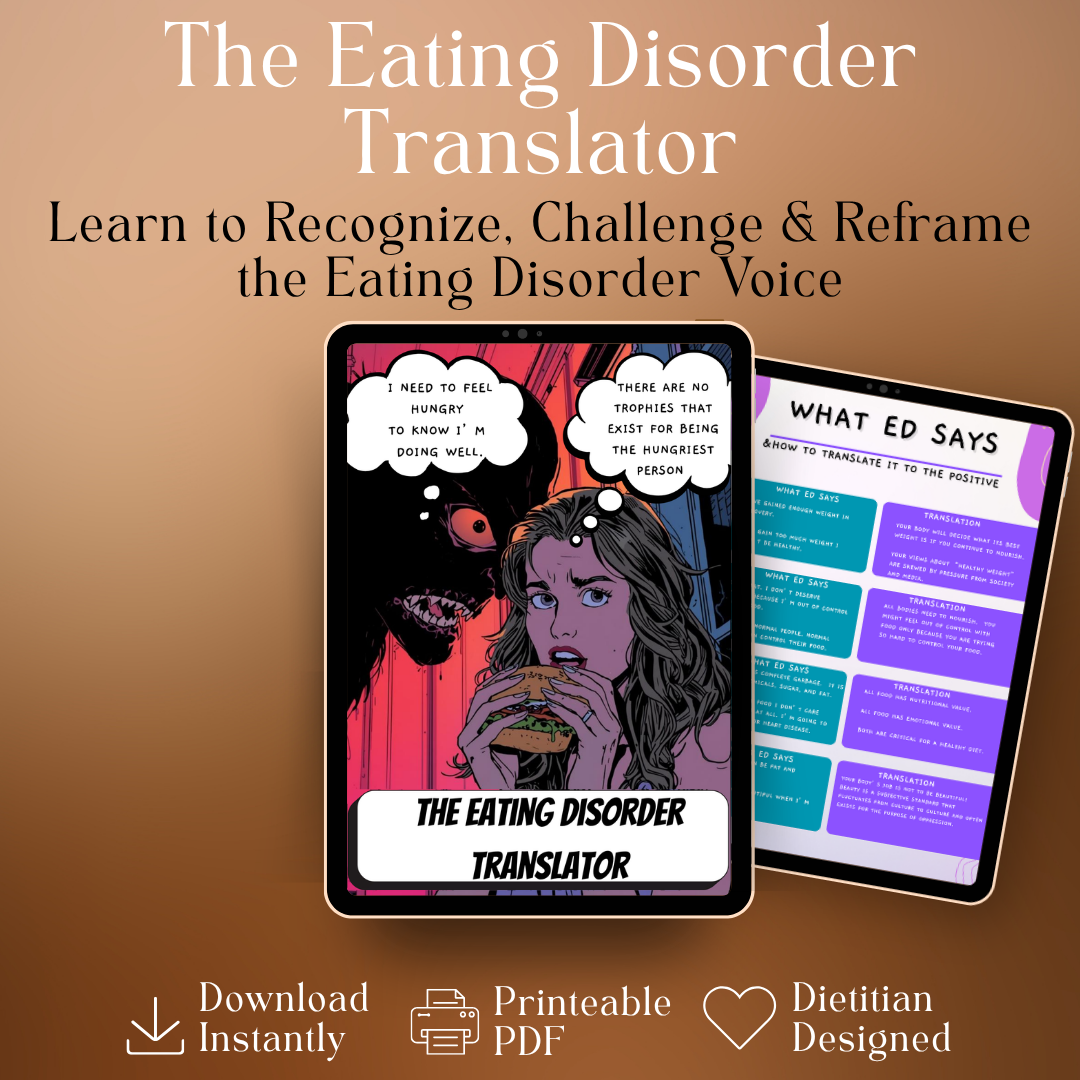
The Eating Disorder Translator is a printable clinical resource designed to help providers identify these thoughts with clients, challenge the belief underneath them, and introduce a more recovery-oriented perspective.
Help Clients Separate Their Voice From the Eating Disorder
One of the hardest parts of eating disorder treatment can be helping clients recognize when a thought is coming from them and when it’s coming from the eating disorder.
Because eating disorder thoughts don’t always sound disordered.
They can sound completely reasonable:
- “I haven’t earned food today.”
- “I should probably eat less.”
- “I need to exercise because I ate more.”
- “Resting is lazy.”
- “My body changing means I’m doing something wrong.”
- “I can’t trust myself around that food.”
When these thoughts have been repeated long enough, they can start to feel less like eating disorder symptoms and more like facts.
The Eating Disorder Translator is a printable clinical resource designed to help providers identify these thoughts with clients, challenge the belief underneath them, and introduce a more recovery-oriented perspective.
Introducing the Eating Disorder Translator
Think of it as a cheat sheet for translating eating disorder logic into recovery language.
Instead of simply telling a client that an eating disorder thought is “wrong,” the Translator gives you language for exploring what the eating disorder is saying and what a recovery-oriented response might sound like instead.
Use it during sessions, send it home with clients, incorporate individual statements into treatment, or keep it nearby when you need another way to respond to a particularly stubborn ED thought.
Translate Common Eating Disorder Thoughts
ED Says:
“I haven’t exercised enough to deserve food.”
Recovery Says:
“Food is a biological need, not a reward for movement.”
ED Says:
“Rest days are lazy days.”
Recovery Says:
“Rest is a necessary part of physical and mental health.”
ED Says:
“No one will love me if my body changes.”
Recovery Says:
“My worth and lovability are not determined by my body size.”
These aren’t meant to become another list of “correct” things your client is supposed to believe.
They’re conversation starters.
What makes the ED statement feel true? What is it asking the person to do? What happens when they obey it? What evidence supports the recovery response? What might change if they practiced responding differently?
A Practical Tool for Eating Disorder Sessions
The Eating Disorder Translator can help providers work with clients around:
✅ Identifying eating disorder thoughts
✅ Externalizing the eating disorder voice
✅ Challenging rigid food and movement rules
✅ Exploring beliefs about weight and body size
✅ Addressing guilt associated with eating and rest
✅ Developing alternative responses to ED thoughts
✅ Practicing more compassionate self-talk
✅ Building flexibility around food, movement, and recovery
Who Is This Resource For?
The Eating Disorder Translator was created for professionals working with eating disorders, disordered eating, food anxiety, and body image concerns, including:
- Dietitians
- Therapists and counselors
- Physicians
- Nurse practitioners and physician assistants
- Eating disorder treatment programs
- Other healthcare professionals supporting eating disorder recovery
It can be used across outpatient sessions, treatment programs, groups, or as a take-home resource when clinically appropriate.
Especially Helpful When Your Client Says…
“I know that’s the eating disorder talking, but it still feels true.”
That’s the space this resource is designed for.
Recognizing an eating disorder thought is one step. Learning how to respond to it differently is another.
Rather than leaving clients with “don’t listen to your eating disorder,” the Translator provides concrete examples of what challenging the ED can actually sound like.
Ways to Use the Eating Disorder Translator
During individual sessions:
Choose a statement that closely matches something your client has been struggling with and explore the ED belief versus the recovery response.
As a take-home resource:
Give clients language they can return to when eating disorder thoughts show up between appointments.
For meal support:
Use relevant translations before, during, or after meals when ED thoughts become particularly loud.
For journaling:
Have clients identify their own version of an ED statement and develop a recovery-oriented translation.
For group treatment:
Use individual statements as discussion prompts around common eating disorder beliefs and recovery.
For providers newer to eating disorder treatment:
Keep the resource available as a quick reference for language that supports recovery without reinforcing food rules, compensatory behaviors, or weight-focused thinking.
What You’ll Receive
✔ Instant digital download
✔ Printable PDF format
✔ Common eating disorder thoughts paired with recovery-oriented responses
✔ Practical language you can use during sessions
✔ A resource that can be incorporated into individual or group work
✔ A simple tool you can return to when ED logic has taken over the conversation
Less “Just Don’t Listen to the Eating Disorder.”
More:
“Let’s figure out what the eating disorder is telling you, why it feels so convincing, and what recovery might say back.”
The Eating Disorder Translator gives providers practical language for doing exactly that.
Add the Eating Disorder Translator to Your Provider Toolbox
Use it in sessions, incorporate it into treatment, and help clients practice recognizing when the eating disorder is doing the talking.
Because sometimes recovery starts with learning that not every thought deserves the final say.
Only logged in customers who have purchased this product may leave a review.
Vendor Information
- Store Name: Eating Disorder Vault
- Vendor: Eating Disorder Vault
- No ratings found yet!



Reviews
There are no reviews yet.